The learning goal that I have identified to teach is the author’s development of character in literature. I have selected two learning theories from Chapter 4 to demonstrate the achievement of this learning goal. The first learning theory I am using is the Cognitive Information Processing Theory, and the second theory I am using is Constructivism.
The Cognitive Information Processing Theory supports the idea that stimuli become input; behavior becomes output, and information processing is what happens in between.
Thus, the learner must pay attention in order to learn, make meaningful connections between the new information and prior knowledge, and be able to recall and apply information from memory. In order to teach characterization in literature, I would explain that the author helps the reader become acquainted with the characters by what the character does, and by what the character says in the story. I would then proceed to guide the learner to rely on his/her prior knowledge to think of someone they know and write down some character traits about that person based on what the learner saw the person do and what the learner heard them say. I would provide the learner with feedback to validate the correctness of this information or to provide information to modify the learner’s concept of characterization. I would then proceed to select various pieces of literature to read with the learner. I would have the learner identify the traits in the characters and note how the author developed these characters. For added emphasis, I would help the learner use highlighting tape to highlight the words, sentences, or passages that describe or demonstrate the personality of the character. With teacher guidance, the learner could use blue highlighting for words, sentences, and passages that describe one character, then use yellow to highlight information on the second character, and so on. According to information processing theory, this highlighting strategy, or use of graphical diagrams and imagery strategies can help learners make meaningful connections between their prior knowledge and new information. The last activity I would use is to find more literature pieces with developed characters, and have the learner continue to use the highlighting strategy to highlight the behaviors and dialog that show evidence and development of that character’s personality. The learner could transfer this information over to a three column chart (recommended graphics of information processing) labeled as such: Name of Character, Text Description/demonstration of Character, and Trait.
Constructivism works in contrast to the information processing theory. Information processing theory supports the idea that information comes from the outside (environment) into the learner. Constructivism, on the other hand, states that information learning occurs from the inside out. Constructivism is also more complex because it deals with higher levels of the thinking processes other than just comprehension and rote memory. To teach characterization using constructivism, I would use non-fiction literature selections as well as fiction. Students might determine the character behavior and traits of a former US president, or a famous sports personality. This would follow the constructivism theory of engaging learners in authentic or “real” activities. Working in pairs or groups with other students also exposes the learner to the perspectives of others which is another facet of constructivism. I would also have the learner set his/her own learning goals and regulate their learning accordingly, as constructivism dictates. For example, one learner might prefer to find common character traits among Democratic Presidents as compared to those of Republican Presidents. Another student might want to explore the character traits and behavior of a favorite super hero and that hero’s villain. Then, to allow students to reflect on what they learned, they could either produce a “wanted” poster on their characters or perform a brief role play of each character demonstrating those traits and behaviors. The student “audience” could make educated guesses of naming that character or person. The student who explores the character traits of former presidents could present a pre-written campaign speech for the one he/she supports, including the character traits of that person, in order to persuade and gain voters.
I found two references on Gagne’s Nine Events of Instruction but the web site listed is the one I found the most helpful. I was skeptical that Lawson’s article did not describe Gagne’s events specifically – rather that it described just his earlier learning theories. Thus my table is based on information from the web site article.
http://www.csulb.edu/~dkumrow/conference/learning_theory.html
Lawson, T. (1974). Gagne's Learning Theory Applied To Technical Instruction. Training & Development Journal, 28(4), 32. Retrieved from Professional Development Collection database.
Table: Gagne’s Theory of Instruction vs. First Principles (My comments in green)
1. Gaining attention
(Striking a nerve – alert the learner to focus on what’s coming.)
1. Problem-centered (Let me do the whole task!)
- Real world problem/task
- Show component tasks leading to whole tasks
- Involve a progression
First principles imply the “big picture” to get students’ attention – Gagne states objectives or learning goals.
2. Informing the learner of the objective
(Learner personalize objective – own it)
3. Stimulating recall of prior learning
(Learner remembers former knowledge that can be applied to new knowledge.)
2. Activation (Where do I start?)
- Learner apply prior knowledge or teacher supply relevant experience.
- Learner sees relevance/has confidence to learn
- Use graphic organizers to order information
Both Gagne and first principles applies prior learning
4. Presenting the stimulus
(Motivate the learner)
Gagne suggests activity or information that presents content to be learned. First principles suggest examples consistent with content to be learned. Basically the same concept.
3. Demonstration (Don’t just tell me, show me!)
- Demonstrate – show examples of what is to be learned
- Examples are consistent with content being taught
- Use learner guidance techniques (linguistic and nonlinguistic representation.
5. Providing learning guidance
(Use manipulatives/activities/and various media to guide and stimulate learning.)
Both Gagne and first principles encourage learner’s active participation.
4. Application (Let me do it!)
- Learner practices and applies new knowledge
- Practice and tests are consistent with objectives
- Practice followed by corrective feedback
- Provide coaching/support until learner is performing independently.
- Instruction requires learners to use their new knowledge/kill.
6. Eliciting performance
(Provide hands-on participation)
Gagne and first principles require learner to “perform” what he/she learned.
5. Integration (Watch me!)
- Provide techniques that enable learners to apply new knowledge/skill to everyday life.
- Provide opportunity for learner to publicly demonstrate new knowledge/skill.
- Provide opportunity for learner to reflect on new knowledge/skill.
- Provide opportunity for learner to create using new knowledge/skill
Implementation:
Facilitate learner navigation through the learning task
Appropriate learner control
Effective collaboration
Personalized instruction
7. Providing feedback
(Correct erroneous thinking; reinforce correct concepts)
First principle 4 provides feedback as well as coaching and support during learning process. Gagne provides feedback(7) and assessment(8).
8. Assessing performance
(Learner performs independently by applying new knowledge)
9. Enhancing retention and
Transfer
(Review learner on new knowledge/provide summary of the process learned.)
First principle states personalized instruction = Gagne states independent performance.
First principle 5 states integration of new knowledge = Gagne’s 9 transfer of new learning.
To apply the first principles to the goal of teaching character development in literature, I would present the idea that knowing about character traits will help students to become better judges of character in real life. This knowledge will protect them from deceptive people as well as enable them to identify people whom they can trust and on whom they can rely. Then I would have each student use a graphic organizer to describe someone they know. I would demonstrate character development by presenting many examples of passages from literature showing character development. I would use the overhead to show examples, and also show video clips of those same characters being portrayed in motion picture/TV. Then I would have each student apply this new learning. I would hand out copies of more passages that include development of character along with colored highlighters to allow students to color the pieces of information that describe or develop a particular character. I would monitor each student closely and offer corrective and positive feedback as needed. I would finally give each student the opportunity to demonstrate what they have learned by allowing them to select a person in real life to develop their character by dressing like that person and imitating their character traits/behaviors.
If I were using the whole-task approach to teach character development in literature, I would not only include fictitious characters, but I would also have students identify character traits in people they know personally, and in high-profile or famous people with whom they are familiar. This would provide them with a skill they can use in real life to determine how these people fit into the scheme of life, and in human interactions. In order to teach sets of objectives in the whole task approach, I would scaffold the learner’s performance by providing an example of someone we both know – either famous or not – and identifying their character traits and behaviors that reveal the traits in that person. I would encourage the learner to help me identify those traits and think of situations where that person’s behavior or response to a situation revealed their character. I would use mathemagenic methods to encourage high-risk learning that motivates the learner to invest more time and effort into applying the new skill of identifying character in both fictitious and living characters/persons. I would present someone like Adolf Hitler who showed leadership qualities and had an appealing oral presentation when he gave speeches, yet there was later discovered a “dark” side to his persona. I would have the learner research persons in literature, and in real life, misunderstood for the better or for the worse because of character traits and behavior they exhibited that led to erroneous conclusions about their character. I would hope that abstract knowledge would lead to newer learning about character development.
Table 9.2 ARCS model categories and subcategories
Topic of instruction: Characterization
Attention
Perceptual Arousal: Read some epitaphs from tombstones or funeral service flyers.
Inquiry Arousal: Ask students what they would like for others to say or write about them that displays their character traits.
Variability: Show video streams or clips of persons giving eulogies or introducing speakers. Point out the attributes the introducer lists about the speaker.
Relevance
Goal Orientation: I would make certain to address the cultural diversity represented in my classroom – such as American, Latino, Black, and Chinese.
Motive Matching: As I present the lesson, I would monitor closely for those students who may find the assignment challenging. I would adapt the assignment if necessary to keep it challenging yet doable, and keep the process in small steps to prevent frustration.
Familiarity: I would have students select persons of their own choice to identify character traits. They may select a family member, a close friend, or a famous person that they admire.
Confidence
Learning Requirements: I would closely monitor each student and provide feedback necessary to keep them on track and encouraged in completing the task.
Success Opportunities: Studying character traits in others will help students be more perceptive about others in society. They will learn that knowing the characters of others can help them build relationships that would be safe and provide camaraderie, or to avoid relationships that could prove dangerous or harmful.
Personal Control: The learner will acquire an awareness of character traits in others, and how to judge the character of others to determine if association is desirable or should be avoided. Each learner will have to be the judge in his/her own situation.
Satisfaction
Intrinsic Reinforcement: As students read their library books, they can record the page and paragraph numbers of a character’s dialogue and behavior and then list the character traits of that character.
Extrinsic Rewards: After the students finish their library books with the character documentation they complete, they can reflect on the ending of the book to determine if those traits were consistent with the character’s personality throughout the book.
Equity: I can encourage the student to use character analysis in daily life – not to necessarily judge people as superior or inferior – but to judge their character as a measure of how trustworthy and safe an association with that person would be. This could be applied in friendships, in politics, the work environment, or any real world situation.
Benefits of instructional design: After completing these activities, I see tremendous benefits of engaging in design research. I think instruction is much more potent, effective and relevant if one uses design research because it helps the facilitator think through the learning process very carefully. It provides a road map or blue print to detail every step of the learning process so that no “stone is left unturned”. Design research insures that the instructor is a “man with a plan” and is well prepared to execute that plan smoothly and successfully. Design research also provides a means for the learner to succeed at learning and applying the targeted skill. Research design provides a well thought out plan with a stimulating and detailed process which results in a successful, productive learner.
Sunday, November 14, 2010

Saturday, November 6, 2010
Section 1: Defining the Field
I have learned through previous courses that technology implementation was in progress as early as the 1950’s. However, I am amazed to learn that technology goes back as far as the 1910’s. The methods of instruction have certainly taken on many changes through these past decades. I must admit that many of those decades of changes I experienced first hand! As I reflect on the definitions of instructional design and how they have been redefined through the years, I see clearly that new definitions were necessary in order to adapt to new developments in teaching methods. Instructional design has transformed from a “seeing experience” to a “virtual experience.”
When it comes to terminology to describe this field, I personally prefer the term Educational Technology. In my opinion, Instructional Technology and Instructional design and technology sound teacher centered. These terms imply that a teacher – or someone – uses technology to instruct someone else. However; the term Educational Technology implies that while there may be a teacher, librarian, or other educator presenting or facilitating a lesson, there is the presence of a learner who is actively involved in obtaining and applying knowledge through the use of technology. Also, being a classroom teacher at this writing, I personally never cease to learn from others or from personal experiences. In my work environment, I do present concepts and model instruction, but I also offer opportunities for the students to “discover” information as they participate in group discussions, or as they use computers to locate and synthesize information. I find that I “discover” new information and skills along the way, too. In journal readings I see the progressive trend of using various electronic devices in the learning environment such as iPads, iPhones, and ebooks. I also find in these articles that students are learning independently much more in today’s classroom than the classroom of yesterday. I strongly believe that the learner needs a professional educator to expose them to these electronic devices, but I also believe that the learner should transition over to independency as soon as possible and take charge of new learning, with the professional educator close by to offer support when needed. Having said this, I redefine instructional design as follows:
Educational technology is the execution of best and ethical practices used to impart or acquire knowledge through technology applications that enhance those practices, and encourage active learning which results in enlightenment and independent application of new skills and knowledge. These practices will produce a life-long independent learner who is prepared to function productively in a global community.
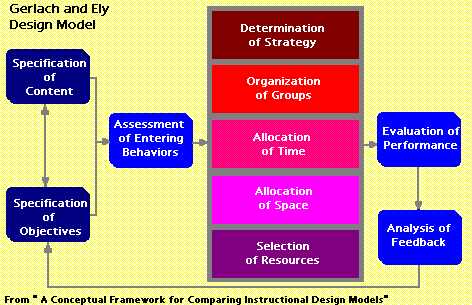
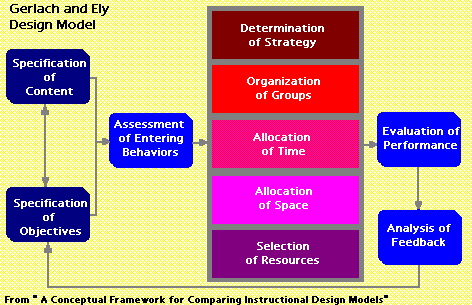
It is interesting to me that we are studying instructional designs, because I just recently had this same conversation with my building principal in a meeting about C-scope. He gave handouts of two designs and we discussed the differences. One of the designs was more traditional, involving direct teaching, and would be a good guide to follow in teaching a particular skill to students. The other model was more inquiry/discovery based which would be effective for teaching a particular concept. I carefully studied the Dick & Carey design and I found it to be a strong, but also a broad guide for planning instruction. I compared the Dick & Carey model to the ones my principal gave me along with about three I found on the Internet. These three included the Backward Design by Wiggins & McTighe, the ASSURE Design by Heinich, Molenda, Russel, and Smaldino, and the Gerlach & Ely Design Model. (See Dick & Clark, Gerlach& Ely images above, and URL link for Backward Design posted below).
(click on images to enlarge)


http://www.arps.org/users/ms/coaches/backward%20design%20101.htm
(Backward Design)
It was difficult for me to see an area needing revision or omission in the Dick & Carey design. I thought I might take bits and pieces from the other models, add those to the Dick & Carey model and thus create a more perfected design. But after my efforts failed, I came to the following conclusion. I think the Dick & Carey model is the best model because one can take other parts from the other models and incorporate them into the D&C model. I find the D&C model to be so broad that I can add specifics to each area and still be following the model without changing it. I have also come to the conclusion, that how an educator approaches and presents a lesson depends on what the lesson is, and on the needs of the students who are participating in the lesson. So, I prefer the D&C model because it seems to be the most versatile design, and I think it would work well with the diversity of students we see in classrooms today.
The Dick & Carey model complies with all of the characteristics of instructional design:
Learner centered – The D&C centers on the learner because it provides assessment of the individual learner and his/her academic needs and learning styles.
Goal oriented – The D&C design addresses specific goals that the learner should achieve at the end of the project. These goals are written out at the beginning of the lesson so that both the instructor and the learner can keep them in focus as they progress through the project.
Meaningful performance – The D&C design allows the learner to not just “see” or “hear” but to actually “experience” or perform behaviors that are authentic and real.
Measured outcomes – The D&C model establishes the need for assessment instruments that are valid and reliable over passing of time and students. These assessments measure real behaviors that students will continue to perform within the global community.
Empirical, iterative, self-correcting instruction – The D&C design clearly makes room for the instructor to gather information on each student based on his/her performance during the project – from beginning to end. The instructor collects data that reveals what the student already knows, and what s/he needs to know. This data guides the instructor to precede one way or another in the instruction. This element allows for students to participate in active learning experiences, to hear repetition if needed, and to self-correct erroneous concepts.
Team effort – The D&C model supports the idea that student learning involves a team of experts to help in the project. The librarian, the community, and business persons can become partners in helping a student achieve a learning goal. This team effort is vital in producing a 21st century life-long learner.
The Dick & Carey model fits in my work environment because it provides a guide for planning instruction to meet all the educational needs of all individuals. Each of my students is very different in interests and backgrounds, so it is imperative to assess each student and provide differentiation in each learning project. It is equally important to have clear goals for the students to focus on so that they can better understand why they need to have the knowledge they will gain from the project. I have found that my students are much more involved in a lesson when they understand exactly what it is they are supposed to learn and why they need this information. As I have stated earlier and inferred in my definition, educational technology involves both the teacher and the learner, and many times they become one and the same = the teacher becomes the learner and the learner becomes the teacher. Education is a constant exchange of these two roles.
Based on what I’ve read about the history of technology in education, as well as what I know about technology innovations, I find electronic devices and tools to be very effective in instruction and learning. Teachers have interactive white boards to add zest to instructional practices, along with overhead projectors, and document cameras connected to Internet-connected computers. Students have access to Web 2.0 tools such as wikis, blogs, Skype, Google Earth, chat, Facebook, and numerous web sites that provide current and valid information. Technology has made it possible to bring unlimited resources into the hands of the instructor and learner. Futuristically, I see iPhones and iPads replacing textbooks as has already happened in some states. I also see more virtual learning taking place via telecommunications. I see educators using blogs and Facebook more in the classroom for global communication between students. I have used blogs on several occasions and I find them to be very effective tools for written expression, for exchange of ideas with others globally, and for imbedding hyper links and images to enhance presentation. It also provides a personal touch because the blog setup provides templates and features that the user may select to design the blog. In a public school classroom of any grade level, students could safely use a blog to demonstrate or reflect on something they learned, to express opinions/ideas, and to interact with the opinions and ideas of others following a code of ethics in the process.
As far as higher education and adult education, technology has become invaluable. Today, people can further, or continue, their education through online courses which are extremely convenient. Just a few short years ago, the added travel time and expense of gasoline prevented many from pursuing higher education degrees. But today, a majority of courses are offered online allowing more flexible scheduling for the user.
For the future, I foresee that there will be an increase in online course participation by under graduates as well as post graduates. I also foresee that more adults will learn technology skills by accessing online courses as well as tutorials available at various web sites. If one has access to an Internet-connected computer, there will be no limit to the amount of information, or to the technologies one can learn in order to keep up in this fast paced world.
When it comes to terminology to describe this field, I personally prefer the term Educational Technology. In my opinion, Instructional Technology and Instructional design and technology sound teacher centered. These terms imply that a teacher – or someone – uses technology to instruct someone else. However; the term Educational Technology implies that while there may be a teacher, librarian, or other educator presenting or facilitating a lesson, there is the presence of a learner who is actively involved in obtaining and applying knowledge through the use of technology. Also, being a classroom teacher at this writing, I personally never cease to learn from others or from personal experiences. In my work environment, I do present concepts and model instruction, but I also offer opportunities for the students to “discover” information as they participate in group discussions, or as they use computers to locate and synthesize information. I find that I “discover” new information and skills along the way, too. In journal readings I see the progressive trend of using various electronic devices in the learning environment such as iPads, iPhones, and ebooks. I also find in these articles that students are learning independently much more in today’s classroom than the classroom of yesterday. I strongly believe that the learner needs a professional educator to expose them to these electronic devices, but I also believe that the learner should transition over to independency as soon as possible and take charge of new learning, with the professional educator close by to offer support when needed. Having said this, I redefine instructional design as follows:
Educational technology is the execution of best and ethical practices used to impart or acquire knowledge through technology applications that enhance those practices, and encourage active learning which results in enlightenment and independent application of new skills and knowledge. These practices will produce a life-long independent learner who is prepared to function productively in a global community.
It is interesting to me that we are studying instructional designs, because I just recently had this same conversation with my building principal in a meeting about C-scope. He gave handouts of two designs and we discussed the differences. One of the designs was more traditional, involving direct teaching, and would be a good guide to follow in teaching a particular skill to students. The other model was more inquiry/discovery based which would be effective for teaching a particular concept. I carefully studied the Dick & Carey design and I found it to be a strong, but also a broad guide for planning instruction. I compared the Dick & Carey model to the ones my principal gave me along with about three I found on the Internet. These three included the Backward Design by Wiggins & McTighe, the ASSURE Design by Heinich, Molenda, Russel, and Smaldino, and the Gerlach & Ely Design Model. (See Dick & Clark, Gerlach& Ely images above, and URL link for Backward Design posted below).
(click on images to enlarge)

http://www.arps.org/users/ms/coaches/backward%20design%20101.htm
(Backward Design)
It was difficult for me to see an area needing revision or omission in the Dick & Carey design. I thought I might take bits and pieces from the other models, add those to the Dick & Carey model and thus create a more perfected design. But after my efforts failed, I came to the following conclusion. I think the Dick & Carey model is the best model because one can take other parts from the other models and incorporate them into the D&C model. I find the D&C model to be so broad that I can add specifics to each area and still be following the model without changing it. I have also come to the conclusion, that how an educator approaches and presents a lesson depends on what the lesson is, and on the needs of the students who are participating in the lesson. So, I prefer the D&C model because it seems to be the most versatile design, and I think it would work well with the diversity of students we see in classrooms today.
The Dick & Carey model complies with all of the characteristics of instructional design:
Learner centered – The D&C centers on the learner because it provides assessment of the individual learner and his/her academic needs and learning styles.
Goal oriented – The D&C design addresses specific goals that the learner should achieve at the end of the project. These goals are written out at the beginning of the lesson so that both the instructor and the learner can keep them in focus as they progress through the project.
Meaningful performance – The D&C design allows the learner to not just “see” or “hear” but to actually “experience” or perform behaviors that are authentic and real.
Measured outcomes – The D&C model establishes the need for assessment instruments that are valid and reliable over passing of time and students. These assessments measure real behaviors that students will continue to perform within the global community.
Empirical, iterative, self-correcting instruction – The D&C design clearly makes room for the instructor to gather information on each student based on his/her performance during the project – from beginning to end. The instructor collects data that reveals what the student already knows, and what s/he needs to know. This data guides the instructor to precede one way or another in the instruction. This element allows for students to participate in active learning experiences, to hear repetition if needed, and to self-correct erroneous concepts.
Team effort – The D&C model supports the idea that student learning involves a team of experts to help in the project. The librarian, the community, and business persons can become partners in helping a student achieve a learning goal. This team effort is vital in producing a 21st century life-long learner.
The Dick & Carey model fits in my work environment because it provides a guide for planning instruction to meet all the educational needs of all individuals. Each of my students is very different in interests and backgrounds, so it is imperative to assess each student and provide differentiation in each learning project. It is equally important to have clear goals for the students to focus on so that they can better understand why they need to have the knowledge they will gain from the project. I have found that my students are much more involved in a lesson when they understand exactly what it is they are supposed to learn and why they need this information. As I have stated earlier and inferred in my definition, educational technology involves both the teacher and the learner, and many times they become one and the same = the teacher becomes the learner and the learner becomes the teacher. Education is a constant exchange of these two roles.
Based on what I’ve read about the history of technology in education, as well as what I know about technology innovations, I find electronic devices and tools to be very effective in instruction and learning. Teachers have interactive white boards to add zest to instructional practices, along with overhead projectors, and document cameras connected to Internet-connected computers. Students have access to Web 2.0 tools such as wikis, blogs, Skype, Google Earth, chat, Facebook, and numerous web sites that provide current and valid information. Technology has made it possible to bring unlimited resources into the hands of the instructor and learner. Futuristically, I see iPhones and iPads replacing textbooks as has already happened in some states. I also see more virtual learning taking place via telecommunications. I see educators using blogs and Facebook more in the classroom for global communication between students. I have used blogs on several occasions and I find them to be very effective tools for written expression, for exchange of ideas with others globally, and for imbedding hyper links and images to enhance presentation. It also provides a personal touch because the blog setup provides templates and features that the user may select to design the blog. In a public school classroom of any grade level, students could safely use a blog to demonstrate or reflect on something they learned, to express opinions/ideas, and to interact with the opinions and ideas of others following a code of ethics in the process.
As far as higher education and adult education, technology has become invaluable. Today, people can further, or continue, their education through online courses which are extremely convenient. Just a few short years ago, the added travel time and expense of gasoline prevented many from pursuing higher education degrees. But today, a majority of courses are offered online allowing more flexible scheduling for the user.
For the future, I foresee that there will be an increase in online course participation by under graduates as well as post graduates. I also foresee that more adults will learn technology skills by accessing online courses as well as tutorials available at various web sites. If one has access to an Internet-connected computer, there will be no limit to the amount of information, or to the technologies one can learn in order to keep up in this fast paced world.

Monday, October 25, 2010
My New Blog
October 25, 2010: My new blog for the beginning of the end. This ETEC 561 class is my last before my Dec. 18th graduation!
Subscribe to:
Comments (Atom)